

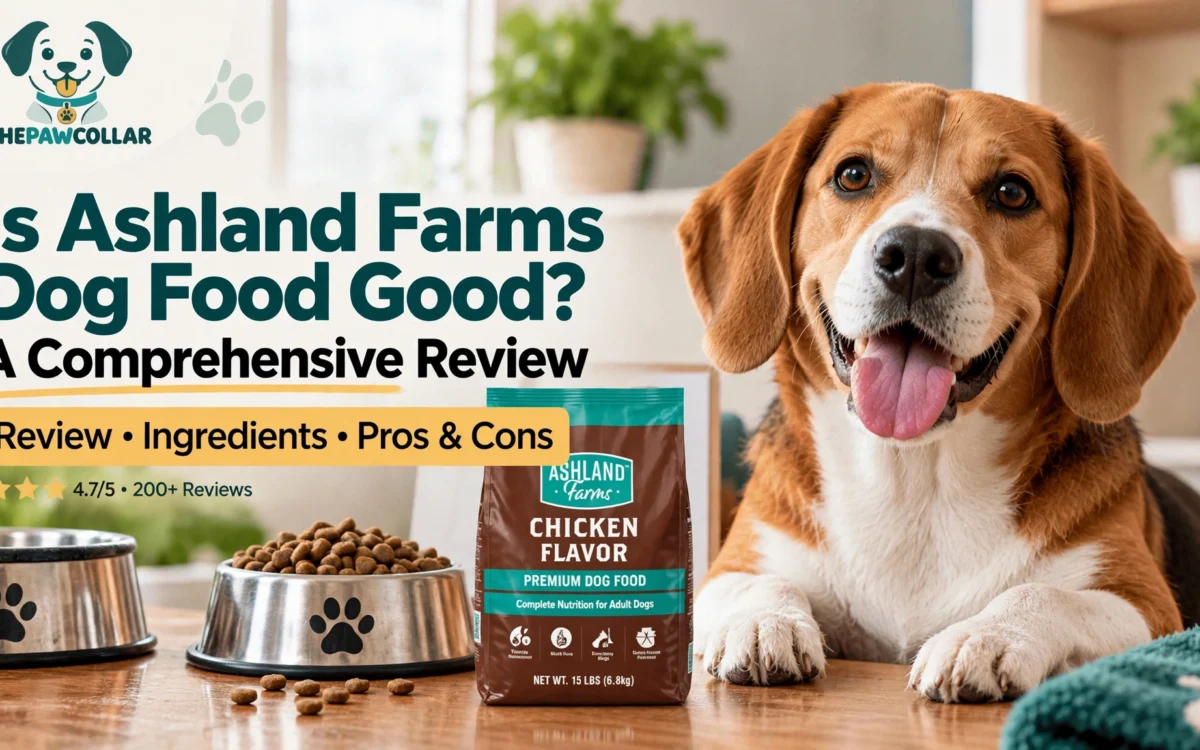
Ashland Farms is a budget dog food line sold through Family Dollar, which makes it appealing to owners who want a low-cost option that is easy to pick up locally. The bigger question is whether a particular Ashland Farms recipe provides an appropriate everyday diet for your dog.
The answer should come from the actual product label. Recipes can change, and dry, wet and puppy foods may have very different formulations. Rather than calling an entire brand good or bad, it is more useful to look at the nutritional adequacy statement, ingredients, calories and the needs of the individual dog.
What is Ashland Farms dog food?
Ashland Farms products are available through Family Dollar, including dry adult food, puppy food and wet foods. Current retailer listings show several different formulas, so the package in your hand matters more than a general description of the brand.
The manufacturer information is not as transparent as it is with some larger pet food companies. Some third-party sources have attributed production to contract manufacturers, but conflicting claims make it inappropriate to state a manufacturer as fact without checking the current packaging.
Look at the nutritional adequacy statement first
AAFCO describes the nutritional adequacy statement as one of the most important parts of a pet food label. It tells you whether the food is complete and balanced for a stated life stage.
If you are comparing Ashland Farms with another budget food, check that statement on both packages. A low price does not automatically make a food inadequate, just as a higher price does not automatically make another food better.
What the ingredient list can tell you
Some Ashland Farms recipes use grains, meat or poultry meals, animal fats, vegetable ingredients, vitamins and minerals. One currently listed steak and vegetable formula includes ground whole grain corn, meat and bone meal, corn gluten meal, animal fat, soybean meal and wheat middlings among its early ingredients.
That profile may not appeal to owners looking for a meat-forward recipe, but ingredient preference is not the same as a nutritional deficiency. Look at the finished food’s adequacy statement and guaranteed analysis as well as the ingredient list.
Potential advantages
The main practical advantage is price and accessibility. For a household that needs an economical complete diet, a properly labeled budget food can be preferable to an expensive food that is difficult to purchase consistently.
The product range also includes puppy and wet options, although each should be checked separately for its intended life stage.
Potential drawbacks
The information available about sourcing and manufacturing can be limited. That does not by itself prove a safety problem, but owners who value detailed manufacturer transparency may prefer a company that publishes more information about formulation and quality control.
Some recipes may also be less appealing to owners who prefer different ingredient profiles. Dogs with allergies, medical conditions or specific nutritional requirements may need a more targeted diet.
Before switching to Ashland Farms
Read the exact package, not a review of a different flavor. Confirm the life stage, calorie content, feeding directions and nutritional adequacy statement.
Transition gradually over several days. Watch stool, appetite, weight and skin. If the dog has a medical condition, is pregnant, is a growing large-breed puppy or has had diet-related problems before, ask your veterinarian before changing the main food.
What about recalls?
Recall status can change, so a static article should not promise that a product has never been recalled. Check the FDA’s current animal food recall information and compare the lot number on your bag with any notice.
This is especially important when buying clearance or older stock. Keep the package and lot information until the food has been used.
Budget does not automatically mean poor nutrition
Price is an imperfect shortcut for judging dog food. A lower-cost food can still meet the nutritional requirements stated on its label, while an expensive food can be unsuitable for a particular dog. The useful comparison is between the actual formulas, not the price tags.
For Ashland Farms, the main questions are straightforward. Is the exact product complete and balanced for the intended life stage? Does the calorie level fit your dog? Can you get the same formula consistently? Does your dog maintain healthy body condition and normal digestion on it? Those answers tell you more than the word premium on the front of a bag.
Why current labels matter
Store-brand foods can have different recipes under the same brand name, and formulas may change. That is why an old review should never be used as a substitute for reading the current package. If an article, retailer page and bag disagree, use the current packaging and contact the manufacturer for clarification.
A practical buying check
- Photograph the front and back of the package before switching.
- Record the exact recipe and life-stage statement.
- Check calories per cup or can.
- Keep the lot number and best-by date.
- Review current FDA recall information when there is a safety concern.
How to compare a budget food fairly
- Compare the nutritional adequacy statement on the exact product.
- Compare calories per cup or can rather than package price alone.
- Check the intended life stage.
- Look at feeding cost per day, not just the cost of the bag.
- Check whether the food is consistently available in your area.
- Consider whether your dog actually maintains good body condition and digestion on it.
A cheaper food can sometimes cost more in the long run if the dog needs unusually large portions, wastes food, or cannot tolerate the recipe. On the other hand, paying extra for a premium label does not guarantee a better outcome for every healthy dog. The most useful comparison is the one that connects the label to the dog’s actual needs.
Read the package every time you change recipes
Even when the brand name stays the same, the recipe, calories, life-stage statement or ingredient list can differ. Take a minute to read the bag before buying a different flavor or size. If you are switching from an adult food to a puppy food or wet formula, do not assume the feeding amount will be the same.
When a food change needs professional advice
A product review can help you understand a label, but it cannot replace an assessment of your dog. Speak with your veterinarian before changing food if your dog has a diagnosed medical condition, unexplained weight loss, repeated vomiting or diarrhea, chronic itching, kidney or urinary disease, diabetes, pancreatitis, or another problem that affects nutrition.
A simple checklist before you buy
- Read the exact product label and check the life stage.
- Look for the nutritional adequacy statement.
- Compare calories and feeding directions, not just the ingredient list.
- Check whether your dog has a health condition that changes dietary needs.
- Buy enough of the food to keep the routine consistent and store it according to the package directions.
The goal is a diet your dog can eat consistently, in the right amount, while maintaining healthy body condition and normal day-to-day health.
Frequently Asked Questions
Is Ashland Farms dog food good?
Ashland Farms is a budget private-label pet food line; reviewers most often describe it as Family Dollar’s store brand, reportedly made by a contract manufacturer. Recipes typically lean on grains and by-product ingredients, and little sourcing information is published. It’s an economy option, not a premium food.
Who makes Ashland Farms dog food?
The manufacturer isn’t officially disclosed. Packaging lists a distributor (Midwood Brands, associated with Family Dollar), and some reviewers report it is produced by Sunshine Mills. One review links it to Rural King instead. Verify with the package before publishing. Because sources conflict, verify the manufacturer on the package before publishing.
Where can I buy Ashland Farms dog food?
Ashland Farms is a store brand, so it’s generally only available through its retailer’s stores and website rather than pet specialty chains. Most reviewers link it to Family Dollar, though one review associates it with Rural King. Availability varies by location, so check your local store.
Is cheap dog food bad for dogs?
Not automatically. A food labeled complete and balanced for your dog’s life stage meets AAFCO minimums, regardless of price. Cheaper foods often use more grain and by-products and less published quality testing. Watch your dog’s weight, coat, stool and energy, and ask your vet.
Has Ashland Farms been recalled?
We didn’t find a widely reported Ashland Farms dog food recall. A 2020 aflatoxin recall affected a different pet food sold at Family Dollar, made by Sunshine Mills. Always check the FDA pet food recall list and compare lot numbers on the bag, since recall status can change.
Related reading
Sources and further reading
A few habits make feeding decisions easier
Keep the food label and a simple feeding record where you can find them. Note the exact product, flavor, life stage and approximate daily amount. This is especially useful when more than one family member feeds the dog. It also gives your veterinarian a clearer picture if a health problem appears later.
Introduce changes deliberately. When several treats, supplements and new foods are added in the same week, it becomes difficult to identify what caused a change in stool, appetite or skin. One change at a time is slower, but it produces much better information.
Finally, remember that food is only one part of health. Exercise, dental care, parasite prevention, sleep, stress and regular veterinary checks all matter. A nutritious bowl cannot compensate for an untreated medical problem, and a perfect ingredient list cannot replace a sensible feeding routine.


